⚠️ Uncleared or non-compliant shipments get held at the border. Get your FSVP right before your next container ships.Get a Free Quote →
PCQI-Certified · FDA · USDA · APHIS · US & Canada Compliance
Will your product clear US Customs?
Complete US and Canadian market entry for food, beverage, supplement, and cosmetics brands — FDA and CFIA registration, FSVP, PCPs, and labeling handled end to end. Or check your product's eligibility instantly below.
Preliminary guidance only — not legal advice. Free, instant, no obligation.
PCQI Certified
AIB International
FSMA Compliant
FDA Registered Agent
US Entity Formation
What We Do
Get your product into the US market
22 services. Each one solves a specific problem:
✓Clearing customs
✓Passing FDA inspection
✓Selling on Amazon
✓Staying compliant year-round
FSVP Plan — Human Food
Your shipment will be held at the US border without a compliant FSVP plan on file.
✓A complete FSVP program built for one supplier, start to finish
✓Includes 1 SKU. Add more from $290 each
✓Label compliance review: $290 per label
✓Canned or acidified foods: add FCE / SID registration for $490
✓Fresh produce may need an extra permit — we'll flag it early
from$990USD
FSVP Plan — Small Importer
A lighter FSVP for very small importers and others eligible for FDA's modified requirements.
✓Written FSVP built to the modified requirements, not a full hazard analysis
✓Covers 1 supplier, 1 product
✓Label compliance review: $290 per label
✓Eligibility confirmed at intake. If you don't qualify, the full FSVP Plan applies
✓Additional products and suppliers quoted separately
from$690USD
Warehouse & Holding Facility Plan
Required for US warehouses that store food but don't make or process it.
✓Safety plan built specifically for storage-only facilities
✓Ongoing monitoring and fix-it steps included
✓Making or processing food on site instead? See the plan below
from$990USD
FSMA Food Safety Plan
Required for US manufacturers and processors — the #1 reason FDA flags a facility is a missing or weak plan.
✓Full food safety plan, written and inspection-ready
✓Recall plan included
✓Simple, single-process facilities: from $1,590
✓Multi-process or higher-risk facilities: from $4,500, or quote only
✓Label compliance review: $290 per label
✓Storage/holding only, no manufacturing? See the Warehouse plan above — from $990
from$1,590USD
Animal Food & Pet Food FSVP
Pet food and animal feed follow different rules than human food.
✓Full FSVP plan built for animal food
✓Covers 1 supplier, 1 SKU
✓Label compliance review: $290 per label
✓Add more SKUs from $290 each
✓Special permits or complex ingredients quoted separately
from$990USD
Dietary Supplement FSVP
Importing supplements? You still need FSVP — just a lighter version, since we check your supplier's manufacturing standards instead of a full hazard review.
✓Covers 1 supplier, 1 product — lighter-touch FSVP review, no full hazard analysis needed
✓Label compliance review: $290 per label
✓Additional SKU: $290
✓Manufacturing domestically instead? See our Dietary Supplement Compliance service
from$990USD
FSVP Agent — E-commerce
As a foreign brand, you need someone based in the US to represent you to the FDA.
✓One flat yearly fee — covers your whole SKU lineup
✓You'll need an FSVP plan first — we can write one if you don't have it
✓Yearly check-ins and FDA contact included
✓We manage your FSVP program and FDA contact — not customs or import filing
✓Doesn't include audits, lab testing, or legal help (available separately)
✓Covers your imports — separate from facility registration
from$1,290/ year
Annual FSVP Monitoring
FDA requires you to review your FSVP plan every 3 years — sooner if anything changes. A low base fee keeps your file current; you're only billed extra when something actually changes.
✓1 supplier, 1 SKU, no changes: $290/yr
✓Add a SKU to an existing supplier: $150, billed when added
✓Add a new supplier: $290, billed when added
✓Change to an existing SKU or supplier (ingredients, process, sourcing): $150 per change
✓Keeps your FSVP program current — doesn't include FSVP Agent duties
from$290/ year
Urgent support
FDA Records Request & 483 Response
When FDA issues a records request or Form 483, you have limited time to respond and the documentation must be complete.
✓FSVP records-request review & response: from $1,490
✓Form FDA 483 response & CAPA: from $2,500
✓24-hour response, full review, and a clear action plan
✓Bigger jobs — new plans, lab testing, legal help — quoted separately
✓Already received a Warning Letter? See our dedicated Warning Letter response service below
from$1,490USD
Urgent support
FDA Warning Letter Response
A Warning Letter is serious — FDA's formal next step after an unresolved 483. Handle it wrong and it can escalate further.
✓FDA Warning Letter response: from $3,490
✓Full investigation, action plan, and supporting documentation
✓24-hour triage and response-timeline planning
✓Already escalated to Import Alert or DWPE? Recovery support quoted separately
✓Bigger jobs — legal help, lab testing — quoted separately
from$3,490USD
US Facility Registration
Every US food facility must register with FDA before your first shipment.
✓$290 one-time — we file everything for you
✓No US Agent required — domestic facilities only
✓Biennial renewal: $190
$290USD
Foreign Facility Registration & US Agent
Every foreign food facility must register with FDA and have a US Agent before its first shipment.
✓Foreign FDA registration and US Agent service: $490/year
✓Registration, US Agent, renewals, and FDA contact — all included
✓Biennial renewal included while the annual service remains active
✓Already have your own US Agent? Registration filing only: $290
✓Filing-only biennial renewal for clients without an active annual service: $190
✓Covers your facility — separate from FSVP Agent
$490/ year
Food Label Compliance Review
A bad label is one of the top reasons shipments get stopped at the border. We check both what's on your label and whether every ingredient is actually allowed.
✓Full label review — $290/SKU, includes one free recheck
✓Related SKU — same flavor family or size, same layout: $150
✓Check if every ingredient is legally allowed: $390
✓Extra redesigns after your free recheck: billed separately
$290USD / SKU
Dietary Supplement Compliance
Dietary supplements are regulated under DSHEA — a distinct, stricter pathway than standard food.
✓Label and health-claims review
✓Manufacturing standards (cGMP) guidance
✓Covers 1 formulation
✓Additional formulation or label: from $290
✓Add-on: check if an ingredient needs FDA notification — $290 (full filing quoted separately)
✓Importing rather than manufacturing domestically? See our Dietary Supplement FSVP service — from $990
from$690USD · 1 formulation
MoCRA Cosmetic Compliance
A 2022 law (MoCRA) now requires every cosmetic brand selling in the US — including foreign ones — to register and meet ongoing safety obligations.
✓Cosmetic facility registration only: $390
✓Cosmetic product listing: $190/SKU
✓Cosmetic label review: $390/SKU
✓Check restricted ingredients: $290
✓Complete initial MoCRA setup incl. first SKU: from $1,190
✓Ongoing safety requirements quoted separately
from$390USD
FCE / SID Registration — Canned & Acidified Foods
Canned, jarred, or shelf-stable acidified/low-acid foods (think pickles, salsa, canned vegetables) need FCE registration and an SID filing before they can be legally imported.
✓FCE registration plus first SID: $790
✓With an FSVP Plan: $490
✓Additional filing, same process: $290
✓More complex filing: from $590
✓Need us to manage the whole process? From $1,490 plus lab costs
✓Covers filing only — recipe testing quoted separately
from$790USD
Certificate of Free Sale
Many countries require a US-issued Certificate of Free Sale before accepting your product for import — it confirms your product is legally sold in the US.
✓Base filing fee: $290, plus $75 per SKU on the certificate
✓Covers application review, corrections, and FDA filing
✓One certificate can list multiple products for the same manufacturer
✓No FDA government fee for eligible dietary supplements — other categories may vary
✓Selling somewhere outside the Hague Apostille Convention (e.g. UAE)? Legalization coordinated with a third-party provider, quoted separately
from$290USD
Seafood Compliance
Seafood follows its own import rule, separate from standard FSVP — but you still need proper documentation.
✓Importer verification plan: $1,490
✓Processor safety plan: from $1,890
✓Both together (saves $490): from $2,890
✓Traceability setup: from $790
✓Label compliance review: $290 per label
✓Additional processors scoped individually
from$1,490USD
USDA/FSIS Compliance Assessment
Beef, lamb, pork, poultry, and egg products are regulated by USDA FSIS — not FDA.
✓Check if your product, country, and supplier qualify
✓Clear guidance on the documents you need
✓Doesn't include filing every permit — we'll tell you which ones you need
✓APHIS permit assistance: from $590 · FSIS label submission/special approval: from $790
✓Country or establishment eligibility projects: quote only
from$890USD
APHIS / VS Permit Application Support
Help preparing and submitting animal-product import permit applications.
✓Review of animal-derived ingredients, source countries and processing information
✓Preparation and submission through APHIS eFile
✓Referral to the appropriate USDA official where required
✓Routine follow-up on application queries
✓ClearPath fee: $190/application · government fee: $303 where applicable (combined $493)
✓Submission work is chargeable even where no government permit fee applies
from$190USD
FSVP Training & Practical Guidance
Practical training for businesses importing human food and beverages, animal food/feed, and dietary supplements.
✓FSVP importer responsibilities
✓Supplier approval and verification
✓Required documents and recordkeeping, product changes and corrective actions
✓FDA inspection preparation, with practical examples and questions
✓Up to 15 attendees per session · duration and content agreed before booking
✓Attendees receive a ClearPath certificate of completion
$490USD · per attendee
APHIS / VS Permittee Representation
A qualifying US permit holder for eligible animal-derived imports.
✓A named qualifying US permittee for the agreed permit scope
✓Routine permit-related communications and coordination
✓Coordination with the manufacturer, customs broker and receiving facility
✓Renewal reminders and guidance on maintaining permit conditions
Packages combine the services most clients need together — at a saving versus buying individually. All prices in USD.
Most Requested
Market Entry
Import Food into the USA — Complete Setup
Everything a foreign manufacturer or first-time importer needs to legally ship and sell food in the US market, in one engagement. Foreign facilities need a US Agent — that's handled for you through ClearPath's affiliated US entity, which serves as US Agent of record.
From$1,590
one-time · full setup included
FDA vs USDA pathway determination
Foreign FDA facility registration & US Agent (Year 1)
Complete FSVP plan — 1 supplier, 1 SKU
Label compliance review: 1 label included
Additional labels: $290 each
Supplier verification documentation
Coordination with your US entity acting as Importer of Record & FSVP importer
Import seafood into the US — every requirement covered
Seafood importers face the most layered obligations of any category. This package covers the full stack in one engagement — so nothing falls through the gaps between FDA, NOAA, and your records.
From$3,590
Combined importer verification & processor HACCP plan
SIMP compliance, reporting & traceability setup
Label compliance review: 1 product category included
Additional labels: $290 each
Follows the seafood-specific importer-verification pathway (21 CFR Part 123) instead of standard FSVP
Species-specific NOAA and FWS/CITES permits scoped separately
Additional processors scoped individually
US Manufacturers
US Manufacturer
Manufacture food in the US — inspection-ready from day one
For US food manufacturers and processors who need a PCQI-prepared Food Safety Plan with registration and label compliance handled in the same engagement. Final price depends on facility complexity and number of hazard categories.
From$1,950
FSMA Food Safety Plan (manufacturing) — PCQI-prepared
US domestic FDA facility registration
Label compliance review: 1 SKU included
Additional labels: $290 each
Hazard analysis, preventive controls & recall plan
FDA inspection-ready formatting
ClearPath can serve as your PCQI
Amazon & D2C
E-commerce
Sell food on Amazon USA or Shopify — FSVP plan + agent, Year 1
Foreign food brands selling direct to US consumers need an FSVP plan written and a US-based FSVP Agent named. This package covers both in a single engagement, with Year 1 agent designation and re-verification included.
From$2,290
Year 1
Complete FSVP plan — 1 supplier, 1 SKU
Year 1 FSVP Agent designation
Label compliance review: 1 SKU included
Additional labels: $290 each
Annual supplier re-verification included
FDA correspondence handling
FSVP applies to you as the importer, not your sales channel — works whether you fulfill via Amazon FBA, Shopify, or a 3PL
Cosmetics
Sell cosmetics in the US — MoCRA registered and label-compliant
MoCRA is now in force. Every cosmetic brand selling in the US must register with FDA and list each product. This bundle handles registration, product listing, and full label and ingredient compliance in one engagement.
From$1,190
Cosmetic facility registration
Cosmetic product listing — 1 SKU included
Cosmetic label review: 1 SKU included
Additional label reviews: $390 each
Ingredient-restriction screening
Additional SKU listings $190 each
Ongoing safety requirements quoted separately
Supplements
US Supplement Import Package
Bring your overseas-manufactured supplement into the US with the essential FDA registration, FSVP and labeling requirements in place.
From$1,590
Foreign facility registration
US Agent service — 12 months
Dietary Supplement FSVP — 1 product, 1 supplier
Label compliance review: 1 product included
Additional labels: $290 each
Customs broker referral
Additional SKU listings $290 each
Additional foreign suppliers quoted separately
US Business Formation
Open a US company from anywhere in the world
You do not need to be a US citizen or resident to form a US LLC. We handle the entire process remotely.
Complete Package
US Market Entry Setup
For international businesses ready to trade in the United States. We handle every step of your US entity formation so you can focus on your product.
$590
one-time · full setup included
US LLC formation (state fees included)
EIN application (IRS Employer ID Number)
DUNS number registration
Registered agent (Year 1 included)
US domain name registration (.com)
Business email setup
US mailing address
US business bank account guidance
Formation assistance only — not legal advice. State filing fees included in price.
Details & exclusions ▾
Not included: state-specific surcharges beyond standard filing, ongoing state annual report/franchise tax filings (your responsibility after formation), registered agent and address renewals after Year 1, tax preparation and bookkeeping, federal and state annual filings, Form 5472 and pro-forma Form 1120 preparation, banking fees, and actual bank account opening (guidance only — no guarantee of bank-account approval).
States requiring a custom quote: California, Massachusetts, Nevada, Delaware, Maryland, Tennessee, North Carolina — these carry either unusually high one-time filing fees or high ongoing annual costs (e.g., California's $800/year minimum franchise tax, Massachusetts's $500 filing fee and $500/year report, Nevada's $425 filing fee and $350/year fee). We'll confirm exact pricing for these states before you commit.
How it works
1
Choose your company name
We check name availability in your chosen state and confirm it is clear to register.
2
LLC filed with Secretary of State
We recommend low-fee, privacy-friendly US states with strong asset protection and no state income tax for international owners.
3
EIN from the IRS
Your Employer Identification Number is required to open a US bank account, pay taxes, and sign contracts.
4
DUNS, domain & email
We register your DUNS number, secure your .com domain, and set up professional business email.
5
Bank account guidance
We guide you through opening a US business bank account — including the best online options available to international LLC owners.
In Practice
Compliance that works in the real world
Every Shipment, Compliant
From factory floor to US port — we manage compliance documentation at every step of the journey.
FDA-Ready Documentation
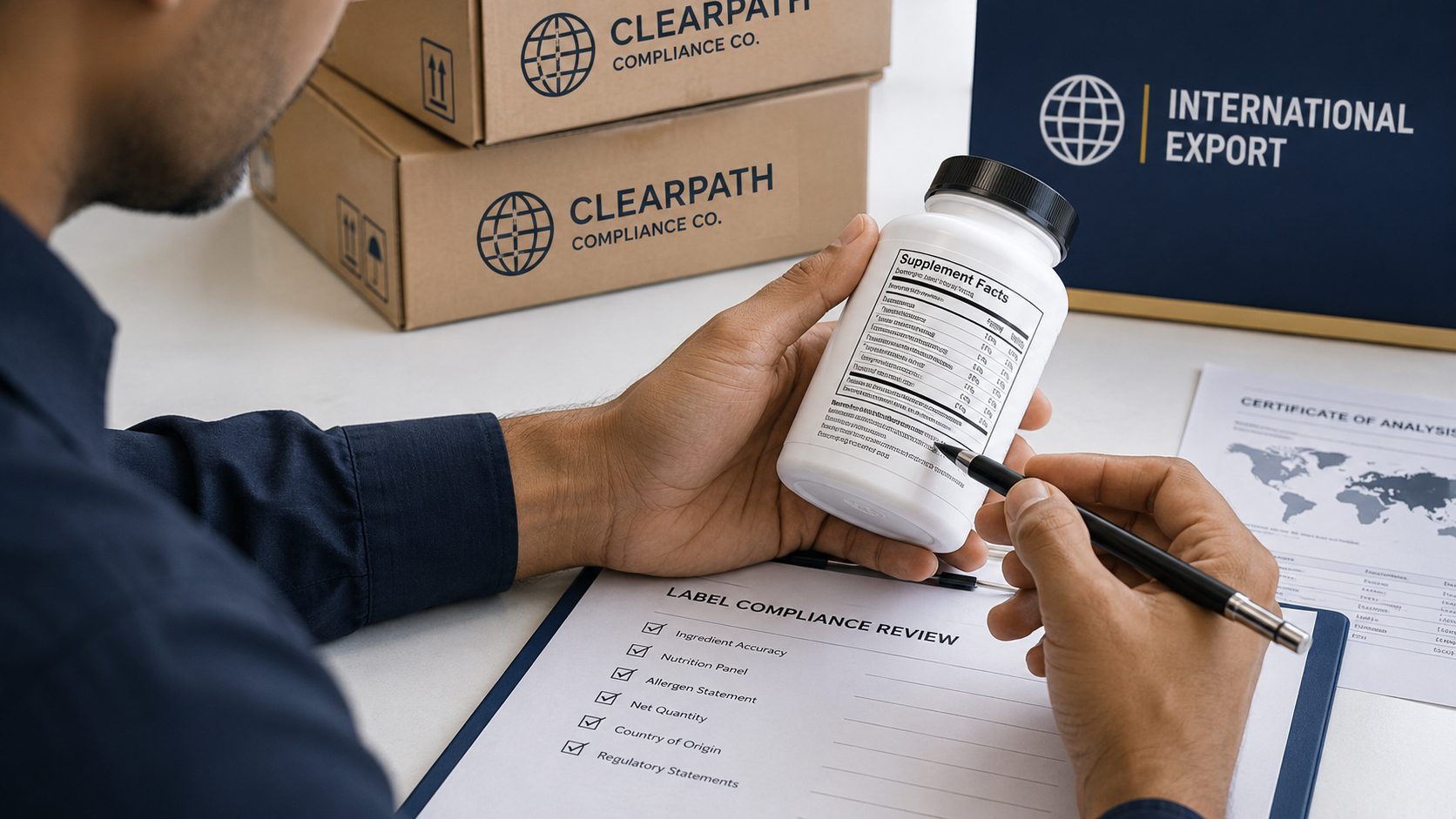
Every plan we deliver is structured to meet 21 CFR requirements and withstand regulatory scrutiny.
Client Stories
What clients say
Real feedback from importers and exporters we've helped get compliant.
★★★★★
"Fast, responsive, and highly professional. Their company formation team made what felt like a complex process incredibly simple, and we were surprised by how quickly everything was finalised."
LC
Laura C.
Wellness Brand Owner · Dubai, UAE
★★★★★
"We needed FSVP compliance fast before our first US shipment. ClearPath delivered a complete, FDA-ready plan with clear explanations at every step."
SL
Sarah L.
Export Manager · Melbourne, Australia
★★★★★
"Excellent service for our dietary supplement labeling review. Their compliance team caught two critical ingredient listing errors before we went to print."
DH
David H.
Health Supplement Brand · London, UK
PCQI Certified · AIB International
The same food safety standard used by Fortune 500 food companies — applied to every plan we write.
Full FSMA Coverage
Every FDA document — written correctly
USA · Australia · Asia · UK
30+ years across four continents
US Formation Specialists
LLC · EIN · DUNS · Banking
Transparent Pricing
Every price published upfront
Dedicated Consultant
PCQI-qualified contact on every job
24hr Response
Quote turnaround within 48 hours
Who We Serve
Food businesses and international founders entering the US market
Our compliance services are specific to food and food-adjacent businesses. Our US formation services are available to any business, any industry, from any country.
🇺🇸
US Food Importers
Small to mid-size importers who need FSVP plans written correctly without paying large compliance firm rates. We deliver the same quality at a fraction of the cost.
🌍
Global Food Exporters
Food producers and manufacturers anywhere in the world targeting the US market. If your product crosses into the United States, we can get you compliant — regardless of country of origin.
🏭
US Food Manufacturers
Domestic food businesses that need a full FSMA-compliant food safety plan, label compliance review, or FDA facility registration support.
💊
Health & Supplement Brands
Nutraceutical and supplement companies entering the US market needing FDA label compliance review, facility registration, and food safety documentation.
🏢
International Business Founders
Entrepreneurs and companies from any country, any industry, who need a legal US business entity — LLC formation, EIN, banking, and full setup. No US citizenship or address required.
🚢
Freight & Logistics Providers
Importers and freight forwarders who need FSVP plans for their food-importing clients. We work directly with brokers and logistics providers on a referral basis.
Free Guides
Resources for food businesses entering the US market
Plain-English guides written by our PCQI-certified team. No paywalls, no sign-ups.
A printable step-by-step checklist covering facility information, US Agent requirements, registration details, and post-registration obligations. Enter your email and we'll send it straight to your inbox.
No spam. Unsubscribe anytime.
FAQ
Common questions
Select a category or browse all questions below.
FSVP (Foreign Supplier Verification Program) applies to US importers of food from foreign suppliers. It requires the US importer to verify that their foreign suppliers produce food in a manner that meets US safety standards. FSMA Preventive Controls (21 CFR Part 117) applies to US domestic food manufacturers and processors. It requires a written Food Safety Plan covering hazard analysis, preventive controls, monitoring, corrective actions, and verification. Both are FSMA rules, but they apply to completely different entities. If you are bringing food into the US from overseas, you need FSVP. If you are manufacturing or processing food inside the US, you need a Preventive Controls Food Safety Plan. ClearPath is PCQI-certified and handles both pathways.
Yes — under 21 CFR Part 117, your Food Safety Plan must be prepared by, or under the oversight of, a Preventive Controls Qualified Individual (PCQI). A PCQI is someone who has successfully completed FSPCA training or has equivalent job experience. Many small food businesses do not have a PCQI on staff, which means they must either hire one or engage an external PCQI consultant. ClearPath is PCQI-certified and can serve as your qualified individual for the preparation of your Food Safety Plan, ensuring your documentation meets FDA requirements and is defensible at inspection.
A Foreign Supplier Verification Program is required by the US FDA for any business importing food into the United States. It documents your hazard analysis and the steps you take to verify your foreign suppliers are producing food safely.
FSVP applies to most US food importers regardless of size, with two important distinctions. First, very small importers — those with less than $1 million in annual combined US human food sales and import value — are not required to maintain a written FSVP program, though supplier verification activities still apply. The threshold is $2.5 million for animal food importers. Second, certain product categories are exempt from FSVP entirely: seafood importers are covered instead by the Seafood HACCP importer rule under 21 CFR Part 123, and juice importers fall under the Juice HACCP rule under 21 CFR Part 120. We assess your category and size during intake and apply the correct compliance pathway.
Yes. FDA requires that foreign suppliers are verified before food products are presented for US entry. Importing without a compliant FSVP in place exposes you to shipment refusal, import holds, and potential import alert listing. Your FSVP must be established prior to your first shipment.
The FSVP importer must verify that food is produced to the standards of the Preventive Controls for Human Food, Preventive Controls for Animal Food, or Produce Safety Rule — whichever applies. They must also verify that food is not adulterated or misbranded with respect to allergen labeling. These obligations cannot be delegated — they rest with the US importer of record.
Suppliers controlling hazards that could cause serious adverse health consequences or death must be audited on-site annually unless a documented food safety justification supports an alternative approach. Other verification methods include lot-by-lot sampling and testing and review of the supplier's own food safety records. We design the appropriate verification program for each supplier based on hazard level.
No — you do not write a new FSVP plan each year. Under 21 CFR §1.506(e), you are required to reassess the adequacy of your FSVP at least once every three years, or sooner if you become aware of new information about a hazard or your supplier's performance — for example a new product, a new hazard, a supplier process change, or a regulatory update. If nothing material has changed, your original FSVP plan remains valid — you simply document that the reassessment took place. While the regulatory minimum is three years, ClearPath recommends more frequent check-ins so supplier or regulatory changes get caught early; our Annual FSVP Document Monitoring service does exactly this from $690 per year for one supplier and up to three related SKUs (additional suppliers from $390/yr, additional products from $190/yr) for existing clients.
Yes. A foreign-owned US LLC can act as the FSVP importer for its parent company's food shipments. We can both form the US entity and write and implement the FSVP program — a natural combination of our two core services.
Yes. Animal feed and pet food are subject to FSVP requirements under FSMA, the same as human food. If you are importing pet food, animal treats, or animal feed into the United States, you are required to have an FSVP program in place before the first shipment. ClearPath writes FSVP plans for both human and animal food importers.
Yes — ClearPath handles the entire FSVP plan from start to finish. Our standard FSVP engagement covers one foreign supplier and one SKU. This includes the complete written FSVP plan, hazard analysis, supplier verification procedures, and record-keeping templates, all formatted to FDA requirements and ready for inspection. Additional products from the same supplier can be added for $390 per standard-risk SKU or $590 per higher-risk SKU (seafood, fresh produce, supplements, or spices), where the product shares a sufficiently similar supplier/facility, process, ingredient and hazard profile. An additional supplier with a substantially similar product starts from $590; a different supplier with a materially different product or hazard profile may require a new FSVP plan at the full starting price.
All ClearPath plans are structured to meet 21 CFR Part 1 Subpart L requirements, with clear hazard analysis rationale and complete verification records designed to withstand FDA inspection.
Yes. We provide corrective action guidance for importers who have received FDA import alerts, warning letters, or refusals. This includes reviewing your existing FSVP program against FDA findings, identifying gaps, and updating your documentation to address the specific deficiencies raised. If you are facing an active import alert, we recommend contacting us immediately as timelines for response are typically short. Corrective action support is scoped individually — contact us via the client portal to discuss your situation.
For FSVP: your supplier name, address, product description, and any existing food safety certifications they hold. We guide you through a simple intake questionnaire once engaged.
All plans are delivered in editable Word format plus PDF. You own the documents outright — no lock-in or proprietary software required.
A single FSVP plan typically takes 1-2 weeks from the time we receive supplier information. Multi-supplier packages or food safety plans may take 3-4 weeks. Rush timelines are available on request.
We service clients worldwide — across the US, Europe, Asia, the Middle East, Australia, New Zealand, and beyond. Wherever you or your suppliers are located, every plan is written to US FDA requirements, because the destination market is what determines the rules. Remote delivery means there is no difference in service whether you are in Sydney, Singapore, or San Francisco.
FDA publishes detailed FSVP guidance at fda.gov. The most relevant document is the Guidance for Industry: Foreign Supplier Verification Programs for Importers of Food for Humans and Animals, updated January 2023. Our team works directly from this guidance when developing every FSVP plan.
No — seafood importers are not subject to the standard FSVP rule. Instead, seafood is governed by 21 CFR Part 123, the Seafood HACCP rule, which is a separate and distinct compliance pathway. Seafood importers must verify that their foreign processors have and implement HACCP plans, and must maintain records of that verification. This is separate from FSVP, which applies to all other food categories.
Under 21 CFR Part 123, US seafood importers must verify that every foreign processor they import from has and implements a HACCP plan for each seafood product. This verification must be documented and records must be maintained and available for FDA inspection. Importers must also take corrective action if a foreign processor is found to be out of compliance. ClearPath provides complete Seafood HACCP importer compliance documentation covering one processor and one product category.
NOAA Fisheries permits are required for importing species managed under US fishery management plans, including most commercially significant marine species. Heavily regulated species include Atlantic tuna (covered under CCSBT and ICCAT quotas), swordfish, sharks, and certain reef fish. ClearPath provides species-specific NOAA permit guidance as part of our seafood compliance services.
Potentially yes. Certain abalone species — particularly green abalone and white abalone — are listed under the Endangered Species Act and require US Fish and Wildlife Service import permits. Southern Hemisphere abalone species such as those from South Australia and Tasmania are not ESA-listed but may still be subject to CITES documentation requirements depending on country of origin. We assess your specific species and source before advising on permit requirements.
DAFF Systems Recognition is a program under Australia's Department of Agriculture, Fisheries and Forestry that certifies Australian food exporters as meeting international food safety standards. When a supplier is DAFF-certified, it can provide evidence of compliance that may reduce the verification burden within your FSVP program — potentially streamlining the documentation required. This applies to Australian food exporters broadly, not just seafood. ClearPath assesses DAFF pathway eligibility for all Australian and New Zealand supplier engagements at no extra charge.
Yes. Live seafood — including live lobster, live crab, and live molluscs — has distinct import requirements covering animal health, aquatic invasive species risk, and state-level permits in addition to FDA Prior Notice requirements. Some live species also require APHIS or FWS permits. We advise on the full permit and compliance picture for live product lines.
The USDA Food Safety and Inspection Service (FSIS) regulates meat, poultry, and certain egg products in the US. Most other food — including packaged food, fresh produce, seafood, dietary supplements, and beverages — is regulated by the FDA. If you are importing beef, lamb, pork, chicken, turkey, or processed egg products, your compliance pathway goes through USDA FSIS rather than FDA. This means FSVP does not apply — instead you need country eligibility, approved establishment listing, and FSIS port-of-entry inspection. ClearPath provides USDA/FSIS import guidance for meat and poultry importers.
Yes. Before any meat or poultry product can be imported into the US, the exporting country must have been determined by USDA FSIS to have an equivalent food safety inspection system. The specific processing establishment must also be listed on the FSIS approved foreign establishment register. Both the country eligibility determination and individual establishment listing must be in place before your first shipment. ClearPath assesses establishment eligibility and guides the listing process for foreign meat and poultry processors.
No. Beef, lamb, pork, poultry, and egg products are regulated by the USDA Food Safety and Inspection Service (FSIS) under the Federal Meat Inspection Act — not by FDA. FSVP only applies to FDA-regulated foods. Instead, FSIS requires country eligibility, approved establishment listing, and port-of-entry inspection. Australia holds FSIS equivalence for beef and lamb. One nuance: heavily processed multi-ingredient products containing meat — such as shelf-stable sauces or soups — may fall under FDA jurisdiction depending on composition. We assess your specific product during intake.
Yes — under the Modernization of Cosmetics Regulation Act (MoCRA), which came into effect in 2022, all cosmetic manufacturing facilities must register with FDA and all cosmetic products must be listed. This applies to both domestic manufacturers and foreign facilities whose products are distributed in the US. The responsible person (the brand or importer) is required to maintain records and comply with MoCRA labeling and safety substantiation requirements. ClearPath handles facility registration ($390), product listing ($190 per SKU), cosmetic label review ($390 per SKU), and ingredient-restriction screening ($290 per formulation) for cosmetics and personal care brands entering the US market — registration and listing alone do not constitute complete MoCRA compliance; ongoing safety substantiation, adverse-event systems, and responsible-person obligations are scoped separately.
Yes — fresh fruit and vegetables are subject to FSVP. However, produce importers have an additional obligation: their FSVP must incorporate verification that their foreign suppliers comply with the Produce Safety Rule (21 CFR Part 112), which sets on-farm standards for water quality, worker hygiene, equipment sanitation, and soil amendments. The PSR verification is built into the hazard analysis and supplier verification activities within the FSVP plan — it is not a separate standalone compliance purchase. ClearPath scopes PSR requirements as part of every fresh produce FSVP engagement.
An NDI notification is a submission to FDA required for any dietary supplement ingredient that was not marketed in the US before October 15, 1994. The notification must demonstrate a reasonable expectation of safety for the ingredient. ClearPath provides NDI status assessments — reviewing your ingredient list to identify whether any ingredients trigger the NDI notification requirement. This is an assessment service only: ClearPath identifies the obligation and advises on next steps, but does not draft or file NDI notifications. Ingredients that require notifications are complex regulatory submissions best handled by specialist regulatory counsel, which ClearPath can refer you to.
No. Any individual or entity from any country can form a US LLC — there is no citizenship or residency requirement. You can own and operate a US LLC entirely from abroad. We handle the complete formation process remotely.
For most ClearPath clients entering the US food market, New Mexico offers the lowest ongoing cost — $50 to form, no annual report fee, and no ongoing state obligations beyond maintaining a registered agent. This makes it ideal for importers and e-commerce businesses who want a clean, low-maintenance US entity. Wyoming is the other popular option — $100 to form, $62 per year for the annual report, but with stronger privacy protections and asset protection laws that may be relevant if you plan to hold assets or IP through the entity. Both states are respected by US banks and the IRS. Year one registered agent service is included at no extra charge with our formation package, then $125 per year from year two.
To open a US business bank account as a non-resident, you will need your LLC formation documents (Articles of Organization and Operating Agreement), your EIN from the IRS, a valid passport, and in most cases a US mailing address (provided by your registered agent). ClearPath recommends Mercury or Relay for non-US residents — both are online-first business banks that are well-suited to international founders, offer no monthly fees, and integrate well with payment processors. Traditional US banks (Chase, Bank of America) generally require an in-person visit with a US address, which makes them less practical for non-residents. Wise Business is an option for international payments but has limited US domestic banking functionality.
Yes — a US registered address is required for your LLC. This is included in our formation package. Your registered agent provides a legal US address for official correspondence and state filing purposes.
LLC formation typically takes 1-3 business days for Wyoming and New Mexico — both states process filings quickly. EIN from the IRS takes an additional 1-4 weeks. Full setup including domain and email is typically complete within 2-3 weeks.
Yes. A foreign-owned US LLC can be designated as the FSVP importer for food shipments owned by its foreign parent company at the time of US entry. This is a common structure for international food businesses entering the US market, and one we help clients establish through our combined formation and FSVP services.
USDA Animal and Plant Health Inspection Service permits are required to import certain agricultural products into the US — including animal products, honey, certain fruits and vegetables, plants, and some food ingredients. The requirement depends on product type and country of origin. We identify your APHIS permit obligations and guide you through the application process.
An Importer Security Filing (ISF) must be submitted to US Customs and Border Protection at least 24 hours before your cargo is loaded onto a vessel bound for the United States. It contains 10 data elements about the shipment. Failure to file results in CBP penalties. We provide complete ISF requirement guidance and help you instruct your customs broker.
Yes, if you are making formal entry shipments valued over $2,500 or importing regulated goods. Most commercial food importers require a continuous customs bond, which covers all shipments for a 12-month period. We provide guidance on bond types, amounts, and recommended surety providers.
The Harmonized Tariff Schedule (HTS) code determines the duty rate applied to your imported goods. Incorrect classification leads to underpayment or overpayment of duties, potential CBP penalties, and delays at entry. We identify the correct HTS codes for your food products and advise on applicable duty rates and any free trade agreement treatment that may apply.
Any food imported into the United States must have FDA Prior Notice submitted before the shipment arrives at the US port of entry — typically at least two hours before arrival for road shipments and eight hours for air. Prior Notice is separate from CBP entry filing and is the importer's responsibility. We provide complete Prior Notice setup guidance as part of our compliance services.
Using a licensed US customs broker is not legally required, but it is strongly advisable for food imports. A customs broker files your CBP entry, submits the Importer Security Filing (ISF), files FDA Prior Notice, and manages any holds or inspections at the US border. Errors in these filings can result in shipment refusal, detention costs, or FDA import alerts. Foreign companies acting as Importer of Record almost always need a broker because they lack CBP system access and a surety bond. Experienced US importers with internal trade compliance staff can self-file, but for most businesses entering the US market for the first time, a licensed broker is essential. Importantly, the customs broker is a separate service from ClearPath — we handle your FDA compliance documentation, they handle the physical clearance of your shipment at the border. You need both. ClearPath can introduce you to a trusted licensed US customs broker who specializes in food imports as part of your engagement, at no additional charge.
ClearPath handles everything that happens before your shipment leaves the foreign country — writing your FSVP plan, conducting hazard analysis, registering your suppliers with FDA, reviewing your labels, and ensuring your compliance documentation is complete and audit-ready. A customs broker handles everything that happens when your shipment arrives at the US border — filing the CBP entry, submitting ISF and Prior Notice, paying duties, and managing any FDA or USDA holds. Neither replaces the other. Think of ClearPath as getting you legally ready to import, and the customs broker as physically getting your goods across the border.
No. There is no separate onboarding or setup fee. Everything needed to get your engagement underway — a dedicated intake call, full regulatory scope confirmation, document collection, and a written compliance roadmap — is included in the price of every service and package. The figure you see is the figure you pay.
An FSVP Agent is a US-based person or company designated by a foreign importer to fulfill FSVP obligations on their behalf, as defined under 21 CFR §1.500. If you are a foreign company importing food into the US without a US entity, you are required to designate a US-based FSVP Agent. The agent's role is entirely regulatory and documentary — maintaining your FSVP program, conducting annual re-verification, and serving as FDA's point of contact for your records. Critically, the FSVP Agent is not the Importer of Record and has no responsibility for customs clearance, duty payments, or CBP entry filings. Those remain the obligation of whoever acts as the Importer of Record. "FSVP Agent" describes the commercial role ClearPath performs for you, not a separately defined FDA regulatory status. ClearPath offers FSVP Agent service from $1,290 per year for one supplier, covering annual reassessment, supplier re-verification, and FDA point-of-contact and records support during standard business hours — provided a compliant FSVP plan is already in place. Audits, laboratory testing, FDA enforcement responses, and legal representation are excluded unless separately agreed.
Each package bundles the services that a given type of client almost always needs together, priced below what the same work would cost purchased individually. For example, the Supplements package combines foreign facility registration, a year of US Agent service, a single-supplier Dietary Supplement FSVP, and a label compliance review, for $1,590. Packages also come with priority email support and a more streamlined delivery process, because we can plan the whole engagement holistically from the start.
The FSMA Preventive Controls for Human Food rule (21 CFR Part 117) requires all registered US food facilities to have a written Food Safety Plan prepared or reviewed by a PCQI. It applies to US food manufacturers, processors, packers, and holders. Very small businesses may qualify for modified requirements.
A PCQI (Preventive Controls Qualified Individual) must prepare or oversee your Food Safety Plan under FSMA. ClearPath's principal is PCQI-certified through the FSPCA and can serve as your PCQI for plan preparation and annual review — included in our FSMA Package.
Under 21 CFR Part 117, a compliant plan must include: a hazard analysis covering biological, chemical, and physical hazards; preventive controls; monitoring, corrective action, and verification procedures; a supply-chain program; and a recall plan. ClearPath delivers all components in FDA inspection-ready format.
FSMA requires full reanalysis at least every three years, or following a significant change in your facility, processes, or ingredients, or after a recall or food safety incident. ClearPath recommends annual review to keep the plan inspection-ready.
Foreign facilities must register with FDA but are covered by FSVP rather than FSMA Preventive Controls directly. However, US importers must verify their foreign suppliers meet FSMA-equivalent standards, so supplier-level FSMA compliance directly affects importer obligations.
Get In Touch
Start your inquiry
Tell us what you need and we'll respond within 24 hours with a clear scope and price.
Our services do not constitute legal advice and do not create an attorney-client relationship. Information provided is for general guidance purposes only and should not be relied upon as legal advice. Clients are advised to seek independent legal counsel for matters involving regulatory enforcement, litigation, import detention, FDA warning letters, or any other matter requiring legal representation. ClearPath Compliance Co. accepts no liability for decisions made in reliance on information or documentation provided without independent legal review. US business formation assistance is document preparation only and does not constitute legal advice.
 Importing into Canada? SFCR & CFIA Compliance →